| HS Code | 557675 |
| Melting Point Celsius | 80-85 |
| Needle Penetration 25c 100g 5s Dmm | 15-25 |
| Oil Content Percent | ≤2.0 |
| Viscosity At 100c Mm2 S | 10-20 |
| Flash Point Celsius | ≥260 |
| Color | white to light yellow |
| Congealing Point Celsius | 80-85 |
| Density At 25c G Cm3 | 0.91-0.94 |
| Average Molecular Weight | 600-800 |
| Acid Value Mg Koh G | ≤0.1 |
| Saponification Value Mg Koh G | ≤0.1 |
| Ash Content Percent | ≤0.03 |
As an accredited 80A Microcrystalline Wax factory, we enforce strict quality protocols—every batch undergoes rigorous testing to ensure consistent efficacy and safety standards.
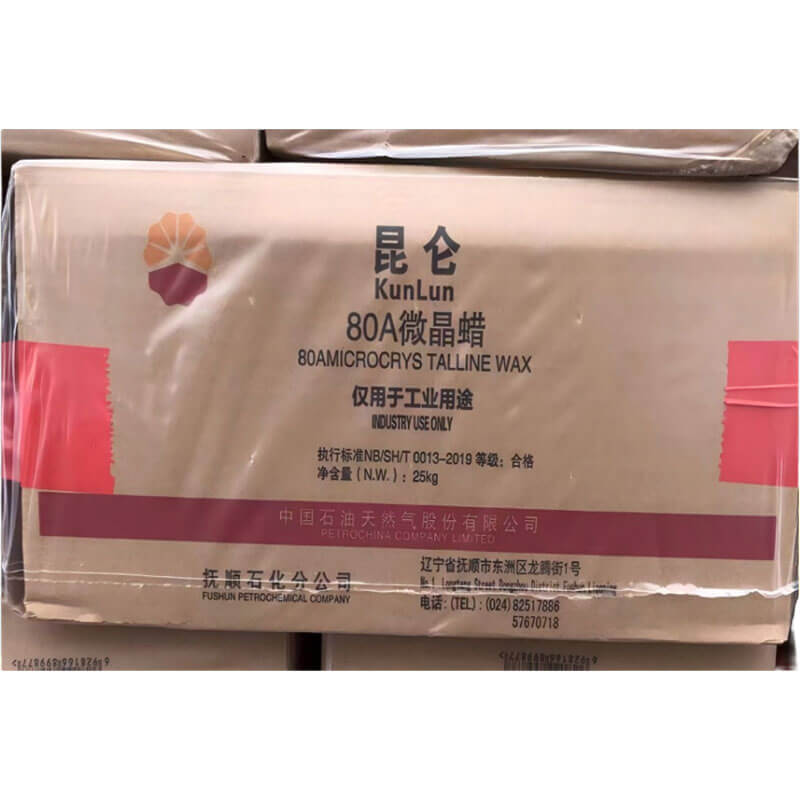
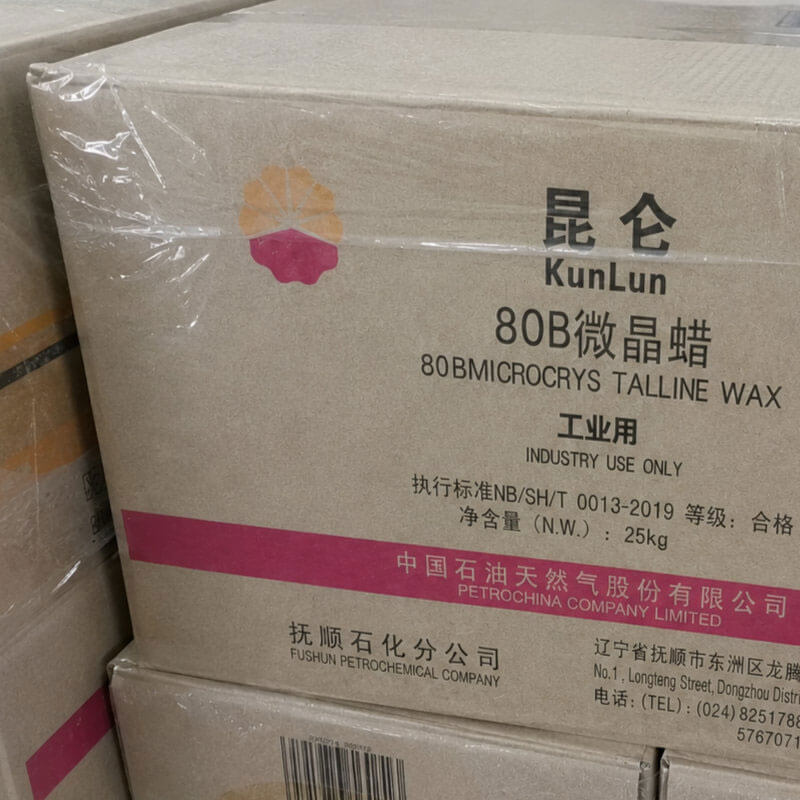
| Packing | 80A Microcrystalline Wax is supplied as 25 kg paper bags on pallets, wrapped in stretch film for safe transport and storage. |
| Container Loading (20′ FCL) | 20′ FCL loading of 80A Microcrystalline Wax: packed in cartons on pallets, securely strapped, ventilated, and protected from moisture. |
| Shipping | 80A Microcrystalline Wax ships as a non-hazardous solid, typically in pellet or flake form. Packed in multi-layer paper bags or boxes on shrink-wrapped pallets. Transport via standard dry van or covered truck, protected from moisture and extreme heat. No special hazmat requirements; handle gently to preserve packaging integrity. |
| Storage | Store 80A Microcrystalline Wax in a cool, dry, well-ventilated area, away from direct sunlight, heat sources, and open flames. Keep containers tightly closed to prevent contamination and moisture absorption. Separate from strong oxidizing agents. Maintain good housekeeping to avoid wax dust accumulation. Ensure area is accessible for inspection and fire safety. |
| Shelf Life | Shelf life is indefinite when stored in a cool, dry place away from heat and ignition sources. |
In case and carton sealing lines where filled packages are palletized at 55–65°C, a conventional paraffin-modified ethylene-vinyl acetate hot melt loses fiber tear and creep resistance. Replacing 30–50% of the paraffin wax with 80A microcrystalline wax at a total wax loading of 2–5 wt% raises the upper service temperature because the branched hydrocarbon structure reduces crystal packing and increases melt viscosity. The wax is introduced into a vertical jacketed mixer with swept-wall agitation after the EVA resin and tackifier have fluxed at 160–170°C. A typical starting formula contains 28–32 wt% EVA with 18–28% vinyl acetate, 45–55 wt% hydrocarbon tackifier with a ring-and-ball softening point of 95–105°C per ASTM E28, 2–5 wt% 80A microcrystalline wax, and 0.5–1.0 wt% antioxidant. The blend is held under nitrogen until a Brookfield Thermosel viscosity of 1,200–2,800 mPa·s at 180°C per ASTM D3236 is reached. Transfer through a gear pump and slot-die applicator at 175–185°C produces a bond with open time of 15–25 s on kraft board at 23°C and set time below 3 s. The critical processing conflict is deacetylation of EVA above 190°C; a viscosity drift greater than 10% over 4 h or acetic acid odor indicates that the hold temperature must be lowered. Excess 80A above 5 wt% lowers peel adhesion to low-energy clay-coated board and is corrected by reducing wax content or increasing tackifier. For food packaging adhesive applications, the formulation is used under 21 CFR 175.105 as an adhesive component. Final products are corrugated case and tray sealing, bookbinding, and high-temperature label attachment.
Truck tire sidewall compounds based on natural rubber and polybutadiene incorporate 80A microcrystalline wax at 1.5–2.5 phr in the Banbury masterbatch after carbon black incorporation and before sulfur curatives. The branched hydrocarbon wax migrates to the rubber surface over a period of 24–72 h after vulcanization and forms an ozone-impermeable film. Because the 80A melting range of 78–82°C per ASTM D127 is higher than standard paraffin wax, the film persists at tire operating temperatures up to 50°C without excessive re-dissolution into the polymer matrix. Compounding is performed in an internal mixer with a drop temperature of 145–155°C; the wax is added at the same stage as stearic acid and antiozonant to ensure dispersion. The batch is then sheeted on a two-roll mill at 60–70°C. Ozone resistance is validated per ASTM D1149 or ISO 1431-1:2022 on dumbbells at 50 pphm ozone, 20% elongation, and 40°C. A production failure occurs when the wax level exceeds 3.0 phr: surface bloom becomes heavy, building tack drops during tire assembly, and the cured part may show visible bloom haze. At plant ambient temperatures below 18°C, the migration rate of this high-melting wax is insufficient in the first 72–96 h; a lower-melting microcrystalline wax or a paraffin/microcrystalline blend is used for winter production. Aromatic process oil above 10 phr is avoided with 80A because oil solubility increases and bloom rate is suppressed. End products include tire sidewalls, conveyor belts, and molded rubber goods where dynamic ozone attack occurs.
Dimensional control in investment casting pattern wax begins with linear contraction data generated on a vertical injection press with a heated platen. In filled pattern systems, 80A is compounded at 25–35 wt% with 30–45 wt% hydrocarbon resin, 2–5 wt% ethylene-vinyl acetate or polyethylene for toughness, and 20–30 wt% filler such as polystyrene or cellulose. The high melt viscosity of 80A, with a lot viscosity at 100°C of 12–18 mm²/s per ASTM D445, assists in suspending filler particles in the melt and reduces density-driven settling during heated pot idling. Injection parameters are set to a melt temperature of 85–95°C, mold temperature of 20–25°C, and injection pressure of 1.0–3.0 MPa. Volumetric shrinkage is measured on a 100 mm × 100 mm × 12 mm slab after 24 h at 23°C; patterns produced with 80A are generally held to 0.8–1.2% linear contraction when the resin fraction is adjusted to compensate for mold temperature drift. The critical threshold is melt viscosity below 500 mPa·s at injection temperature; below that point, filler settling produces non-uniform surface finish and dimensional scatter across a multicavity tool. Ash content is measured per ASTM D482 and must remain below 0.02 wt% for high-integrity superalloy castings to prevent inclusion formation. Autoclave dewaxing is conducted at 150–170°C and 0.5–0.7 MPa steam pressure; a properly formulated pattern releases more than 98% of the wax charge within 10–15 min, with shell blowout controlled by venting. Residual wax in the ceramic shell is burned out at 900–1,100°C. Published data for this specific 80A-filled configuration is limited beyond the supplier certificate, so foundries confirm filler suspension and dewaxing cycle on a pilot tree before full production. End products are turbine blades, orthopedic implants, and structural aerospace castings.
Anhydrous lipstick bases and petrolatum-based ointments incorporate 80A microcrystalline wax at 5–10 wt% to elevate the drop melting point of the oil phase while maintaining deformability on skin. The wax is combined with liquid oils, esters, and butters at 85–90°C in a counter-rotating low-shear mixer until the batch is fully clear; the mixture is then cooled at 2–5°C/min through the crystallization range. A lot needle penetration of 10–20 dmm at 25°C per ASTM D1321 provides a semisolid gel structure when the wax is combined with 20–30 wt% liquid oil. Cooling too rapidly below 2°C/min produces a brittle crystal network that releases oil under compression, while slow cooling above 5°C/min allows coarse crystal growth and a grainy texture in the final stick. For pharmaceutical ointments, the wax must meet the USP-NF Microcrystalline Wax monograph and the supplier must provide documentation for heavy metals and polycyclic aromatic hydrocarbon limits. In the European Union, finished cosmetic products are assessed under Regulation (EC) No 1223/2009; the wax itself is included in the CIR Cosmetic Ingredient Review safety assessment for petroleum-derived waxes. Compatibility with anhydrous systems is broad, but 80A is not dispersed in water-based emulsions without a nonionic emulsifier package and heating above the wax melt point. End products are lipsticks, lip balms, ointment bases, and mascara thickeners.
Folding cartons and corrugated trays that require water resistance and a low blocking tendency are coated with a blend of 80A and food-grade paraffin wax at 10–20 wt% 80A to raise the blocking point of the coating. The melt viscosity at 100°C of 12–18 mm²/s per ASTM D445 maintains curtain stability at the coater head at 105°C. The molten blend is filtered through a 20 µm stainless steel mesh and delivered by a positive-displacement pump to a slot die with a gap of 0.3–0.5 mm. Water vapor transmission rate is evaluated per ASTM F1249 at 38°C and 90% RH; blocking resistance is measured per ASTM D918 at 50°C under 0.5 kg/cm². If the 80A fraction exceeds 25 wt%, the coating may crack on creasing below 10°C and the curtain may exhibit edge thickening due to higher melt elasticity. Final products are frozen food folding cartons, produce trays, and wax-laminated paperboard boxes.
| Regulatory reference | Contact condition | Wax function | Compliance requirement |
|---|---|---|---|
| 21 CFR 176.170 | Paper and paperboard for aqueous and fatty foods | Surface coating component | Extractives limits according to food type and temperature |
| 21 CFR 176.180 | Dry food contact | Impregnated or laminated board | No migration beyond specified extractives |
| 21 CFR 175.105 | Adhesive component | Hot melt adhesive | Good manufacturing practice; functional barrier where applicable |
Container candle formulations that exhibit surface oiling at 35°C are reformulated with 10–20 wt% 80A microcrystalline wax to increase oil retention and raise the drop melting point of the wax pool. The wax is melted with soy wax or paraffin at 75–85°C in a jacketed tank with low-shear impeller agitation, then poured at 65–70°C into preheated glass containers to minimize contraction voids. A 45 mm diameter container with a cotton wick is tested per ASTM F2417 for burn rate, flame height, and soot; the full melt pool is assessed at 3 h of continuous burning. Increasing 80A beyond 20 wt% raises melt viscosity and may reduce fragrance diffusion and wick uptake. Published comparative burn-rate data for this specific 80A/soy/palm hybrid configuration is limited; candle manufacturers therefore confirm performance through pilot pours rather than literature constants. End products are container candles, votives, and wax melts where high-temperature storage stability is required.
Machined ferrous parts shipped by sea in tropical environments are protected by hot-dip wax coatings in which 80A is formulated at 20–40 wt% with paraffin wax and a sulfonate corrosion inhibitor. The coating is applied at 95–105°C in a still-tank dip process; the part is preheated to 60–70°C to reduce thermal shock and ensure a continuous film without pinholes. Salt spray resistance is evaluated on steel panels per ASTM B117 with coating thickness of 50–80 µm; protection beyond 200 h is typical for indoor storage but shorter for exterior exposure. The processing limitation is sagging: if the post-dip cooling rate is below 5°C/min, low-viscosity zones in the film sag before crystallization is complete, leaving thin edges. 80A raises the drop melting point to 78–82°C per ASTM D127, which prevents film flow in container temperatures up to 60°C. When military preservation is specified, the compound is tested against MIL-PRF-16173 for salt spray and humidity exposure. End products are coated gears, shafts, and machined tooling for export packaging.
Competitive 80A Microcrystalline Wax prices that fit your budget—flexible terms and customized quotes for every order.
For samples, pricing, or more information, please contact us at +8618136850665 or mail to sales4@ascent-chem.com.
We will respond to you as soon as possible.
Tel: +8618136850665
Email: sales4@ascent-chem.com
Flexible payment, competitive price, premium service - Inquire now!
80A Microcrystalline Wax is a high-melting petroleum-derived microcrystalline wax whose grade designation denotes a nominal congealing point of 80°C under ASTM D938. The material is supplied as slab or pastille and is registered under CAS 63231-60-7 and EINECS 264-038-1. It consists predominantly of saturated hydrocarbons in the carbon-number range of C30–C50, with a high proportion of branched and cyclic structures and a normal paraffin content significantly below that of conventional paraffin wax. The average molecular weight is centred near 500–800 g/mol. This structural composition creates fine, interlocking crystal domains and a broader melting interval than lamellar paraffin wax.
Class-typical release data position the 80A grade at the hard end of microcrystalline waxes. Needle penetration at 25°C under ASTM D1321, measured with 100 g total load applied for 5 s, falls between 10 and 18 dmm. Kinematic viscosity at 100°C under ASTM D445 falls between 14 and 18 mm²/s. Oil content under ASTM D721 is controlled below 1.0 wt%. Saybolt colour by ASTM D156 is typically not lower than +25, drop melting point by ASTM D127 is usually 83–87°C, and flash point by ASTM D93 is typically above 260°C. Because microcrystalline wax is a refined petroleum fraction, lot-to-lot variation in penetration and oil content is measurable; final formulations should be based on certificate-of-analysis values for the specific production lot.
Industrial lots are commonly supplied as slabs, pastilles, or cartons. Pastillated 80A permits gravimetric feeding and avoids the dusting associated with flaked paraffin wax. Pastilles should be stored below 30°C to prevent cold-flow agglomeration and preserve feeder accuracy. In bulk hot-melt plants, slabs are fed to heated platen melters, while pastilles are better suited to loss-in-weight feeders for continuous compounding.
The transition from solid slab to a pumpable melt is governed by heat-transfer surface area and the temperature differential above the congealing point. In platen melters and jacketed melt tanks, the recommended melt set-point is 100–120°C, with a maximum continuous melt temperature of 140°C to limit oxidative degradation. At 100°C the kinematic viscosity remains above 10 mm²/s; at 120°C it typically falls into the 8–12 mm²/s range under ASTM D445. Spray atomization and slot-die coating require a stable melt viscosity below 1,500 mPa·s at the application temperature. If 80A is introduced as cold pastilles directly into a small melt tank without a heated platen pre-melter, thermal shock can produce localized viscosity stratification and gear-pump cavitation.
On positive-displacement gear pumps delivering 1.5 cm³/rev, melt back-pressure above 40 bar is an operational boundary. High-pressure excursions are typically caused by incompletely melted high-melt fractions or by filter blinding from char and gel particles. Filtration through 50–100 µm depth media is recommended to remove such particulates before the coating die. In drum-melt dispensing systems, heated platen follower seals are usually maintained at 105–115°C. Lower platen temperatures increase fluid viscosity at the follower and can cause seal leakage; higher temperatures degrade the wax and shorten seal life. Published failure data for 80A-specific drum melters is limited.
Moisture from high-humidity storage above 60% RH can generate foam in open melt tanks; material from damaged or open packaging should be dried at 60–70°C for 4 h before melting. The product is not compatible with strong oxidizing agents. Continuous melt exposure above 140°C accelerates oxidative darkening and creates polar oxidation products that increase surface tack and can reduce adhesion in subsequent coating steps.
The fine, interlocking crystal morphology of 80A-class microcrystalline wax is the primary morphological distinction from conventional paraffin wax and lower-melting microcrystalline grades. Table 1 summarises comparative class-typical values.
| Property | 80A-class microcrystalline wax | Conventional paraffin wax | Lower-melting microcrystalline wax |
|---|---|---|---|
| Congealing point (ASTM D938) | 78–82°C | 52–58°C | 60–65°C |
| Needle penetration at 25°C (ASTM D1321) | 10–18 dmm | 12–20 dmm | 25–40 dmm |
| Kinematic viscosity at 100°C (ASTM D445) | 14–18 mm²/s | 3–5 mm²/s | 10–14 mm²/s |
| Oil content (ASTM D721) | <1.0 wt% | <0.5 wt% | <1.0 wt% |
| Dominant crystal morphology | fine, interlocking | large, lamellar | fine, plastic |
| Relative oil retention | high | low | medium |
This morphology has direct consequences in hot-melt adhesives, rubber compounding, and barrier coatings. In hot-melt formulations, 80A reduces mineral-oil exudation and improves cohesive strength at ambient and subambient temperatures compared with paraffin wax. In barrier-paper sizing and laminating, the fine crystal network reduces pinhole density and improves moisture-vapour transmission resistance when evaluated by ASTM F1249. Against lower-melting microcrystalline wax, the higher congealing point of 80A extends the upper service temperature and reduces blocking in coated paper at 40°C and above.
Against Fischer-Tropsch paraffin waxes, 80A has lower crystallinity and higher amorphous content; it therefore exhibits lower brittleness and better oil compatibility but higher melt viscosity. Against polyethylene waxes, 80A has a much lower molecular weight and lower melt viscosity, which permits direct dispersion in oil-containing hot-melt systems without the torque penalties associated with polymeric waxes.
In rubber compounding, 80A is added at 1–3 phr as an anti-ozonant wax in tyre sidewall and industrial rubber goods. Dispersal occurs in internal mixers or twin-screw extruders at stock temperatures above 90°C. Harder lots within the 10–18 dmm penetration range bloom more slowly and form a denser surface film; softer lots bloom faster but may be removed more readily by abrasion and water spray. Addition above 3 phr can reduce green tack of uncured compounds and reduce building tack in tyre assembly.
Hot-melt adhesive and coating lines employ 80A at 5–20 wt% to raise melt viscosity, extend open time, and reduce oil bleed. At 180°C application temperature, the contribution of 80A to blend viscosity is measurable as an increase of 200–600 mPa·s for each 5 wt% added in a mid-viscosity ethylene-vinyl acetate system; published data for this specific configuration is limited, and production batches should be checked by ASTM D3236. At addition levels above 20 wt%, wet-out on low-surface-energy substrates can be reduced, and spiral-nozzle spray patterns may coarsen because of higher melt viscosity.
In candle manufacturing, 80A at 2–10 wt% improves mould release and reduces surface sweating, but addition above 10 wt% can increase melt viscosity and slow capillary wicking in container candles. In cosmetic sticks and petrolatum-based ointments, 80A is used at 1–5 wt% to raise drop point and stabilise the oil phase; batch viscosity should be confirmed by ASTM D3236 or ASTM D445 after cooling.
Polyolefin masterbatch and moulded-part formulations exploit 80A as a lubricant and viscosity modifier. On a co-rotating twin-screw extruder with L/D 40:1, the wax is metered by gravimetric feeder into the feed throat; barrel zone temperatures of at least 95°C are required to achieve complete melting. If the feed zone is operated below 95°C, unmelted high-melt fractions can survive into the die and appear as surface pitting in injection-moulded tensile bars. Tensile properties should be evaluated according to ASTM D638, and melt-volume-flow rate of the finished compound should be checked by ISO 1133-1. Published data for this specific extruder configuration is limited, and processing validation on the intended line is required.
Batch-to-batch variance in needle penetration can shift the lubrication threshold in polyolefin systems. A harder lot at the low-penetration end may require an additional 2–3°C in the mixing zone to achieve equivalent dispersion, while a softer lot may reduce melt viscosity more rapidly. This effect is especially visible in masterbatches where the wax is the sole processing aid.
For food-contact packaging, 80A-class microcrystalline wax may be evaluated under 21 CFR 178.3710 for use in non-food articles, and where direct food addition is permitted under 21 CFR 172.886. Conformance to REACH EC 1907/2006 and EU 10/2011 migration limits must be confirmed with the supplier because production-lot residual oil content and refining severity can shift migration behaviour. The product is incompatible with strong oxidizing agents; continuous melt exposure above 140°C accelerates oxidative darkening and formation of polar oxidation products. In high-humidity storage above 60% RH, moisture uptake can create foaming in open melt tanks; drying at 60–70°C for 4 h is advised before melting.