| HS Code | 495712 |
| Productname | 80B Microcrystalline Wax |
| Appearance | White or ivory-white solid |
| Odor | Odorless |
| Solubility | Soluble in organic solvents, insoluble in water |
As an accredited 80B Microcrystalline Wax factory, we enforce strict quality protocols—every batch undergoes rigorous testing to ensure consistent efficacy and safety standards.
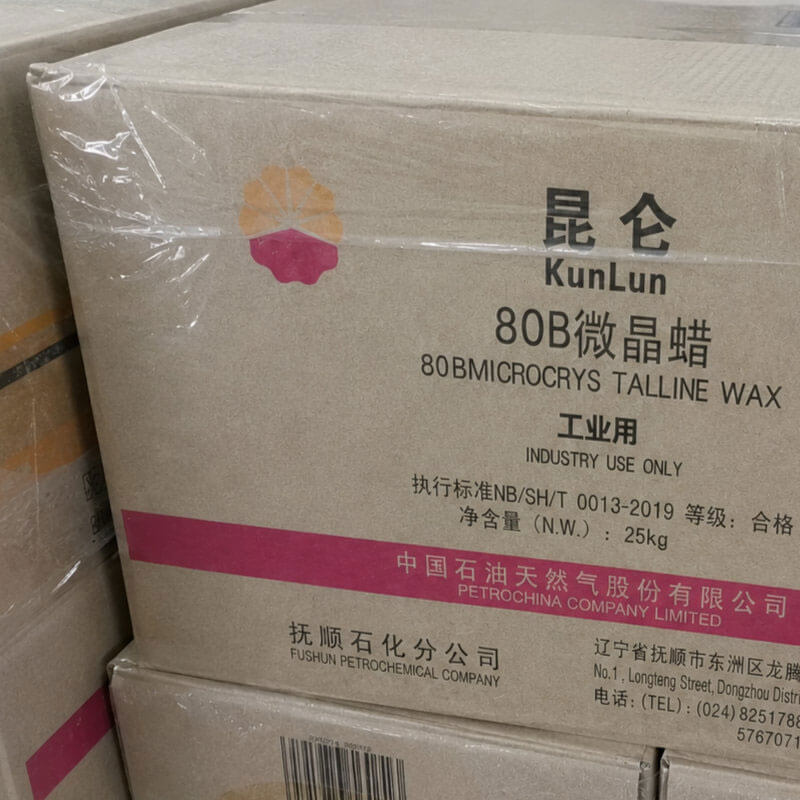
| Packing | 80B Microcrystalline Wax is supplied in 25 kg sealed bags, as solid pastilles, ensuring safe handling and easy storage. |
| Container Loading (20′ FCL) | 20′ FCL loaded with 80B Microcrystalline Wax, palletized and secured, weight optimized for safe, efficient transport. |
| Shipping | 80B Microcrystalline Wax is a non-hazardous solid under normal transport conditions. It requires no dangerous goods declaration. Ship in sturdy, sealed packaging away from heat sources. Ensure proper labeling for handling and storage. Standard freight, air, or ocean transport is acceptable, with no special UN classification required. |
| Storage | Store 80B Microcrystalline Wax in a cool, dry, well-ventilated area away from direct sunlight, heat, and ignition sources. Keep containers tightly sealed when not in use to prevent contamination. Maintain storage temperatures below 40°C (104°F) to avoid softening. Separate from oxidizing agents and foodstuffs. Ensure adequate firefighting equipment nearby. |
| Shelf Life | Shelf life for 80B Microcrystalline Wax is typically indefinite when stored in a cool, dry area away from sunlight and contamination. |
In tyre sidewall and sidewall-scuff compound processing, the 80B microcrystalline wax grade is not an inert filler; it functions as a migratory antiozonant whose protective efficacy depends on a continuous, flexible, regenerable bloom layer. The addition ratio is commonly held between 1.0 phr and 2.5 phr in NR/BR blends, with the lower boundary dictated by insufficient film continuity and the upper boundary by surface adhesion loss and mould deposit formation. A production-scale internal mixer with intermeshing rotors and a drop temperature of 150 °C to 170 °C is typically specified: the wax is charged with zinc oxide, stearic acid, and antidegradants in the non-productive stage to allow complete melting and molecular dispersion before carbon black reaches maximum oil absorption. Excessively early addition below the wax melting range can generate a two-phase morphology that appears as surface specking after cure. The 80B grade, when its supplier certificate shows a drop melting point near 80 °C and needle penetration below 25 dmm under ASTM D1321, produces a denser and higher-softening-point film than paraffin wax components; however, it also blooms more slowly. For tyre service temperatures below 5 °C, a blend of 80B with a lower-melting paraffin wax of 52 °C to 56 °C drop melting point is required to avoid loss of antiozonant protection. Static and dynamic ozone testing under ASTM D1149-16 or ISO 1431-1 is used to quantify cracking resistance, and wax bloom thickness can be assessed through optical or weight difference methods after elevated-temperature ageing. The finished products include tyre sidewalls, retread compounds, and rubber goods exposed to atmospheric ozone. The same migration mechanism can interfere with solvent-based bond adhesion if wax levels exceed 2.0 phr in splice areas; therefore, splice compounds are often formulated with the wax at the lower end of the range.
The limiting variable is not the wax drop melting point alone; it is the interaction between wax crystallinity, tackifier miscibility, and low-substrate-energy adhesion. In ethylene-vinyl acetate-based hot melt adhesives for case and carton closing, 80B is blended at 5.0 wt% to 12.0 wt% of the total formula, usually alongside a paraffin wax or Fischer-Tropsch hard wax. At levels above 12.0 wt%, the higher-viscosity microcrystalline component reduces clean-in-place efficiency and lengthens open time beyond the point where corrugated boxes can be compressed at line speeds above 40 m/min. Viscosity control is conducted with a Brookfield Thermosel according to ASTM D3236, with typical application temperatures of 160 °C to 180 °C. The wax is introduced into a heated, agitated vessel after the EVA and tackifying resin have formed a clear melt; sequential addition prevents micro-wax agglomerates from settling on the tank bottom. A nitrogen-blanketed mixing head is specified because oxidative viscosity drift above 5% of initial viscosity creates deposit formation on slot-die shims. For food packaging applications, the adhesive must comply with FDA 21 CFR 175.105; migration testing under FDA 21 CFR 176.170 may apply when the adhesive is used with paperboard. The finished products include carton closures, bookbinding adhesives, and side-seam adhesives. The grade is not recommended for pressure-sensitive hot melts where tack retention at −10 °C is the primary requirement.
Batch-to-batch variation in congealing point should be monitored by ASTM D938. A shift greater than 2 °C from the approved supplier certificate can alter the ratio of crystalline to plastic phases sufficiently to change notch sensitivity of the applied bead. Published data for this specific grade in slot-die hot-melt coatings is limited; therefore, line qualification should include a minimum 4 h thermal stability hold at 175 °C with viscosity reading every 30 min.
| Control point | Standard/regulation | Test condition or limit |
|---|---|---|
| Dynamic melt viscosity | ASTM D3236 | 160–180 °C, Thermosel |
| Food-contact adhesive status | FDA 21 CFR 175.105 | Migration testing with food simulants |
| Paperboard contact use | FDA 21 CFR 176.170 | Extraction by food type and use condition |
| Thermal stability hold | In-house line qualification | 4 h at 175 °C, viscosity change ≤ 5% |
A container candle formulation using 80B at 10.0 wt% to 20.0 wt% is adjusted to prevent slump and surface cracking without over-wicking. The microcrystalline wax fraction increases oil-binding capacity of a paraffin or soy base; this is measurable by a pressed-oil exudation test at 35 °C for 48 h, with visual oil migration above 1.0% of surface area rejected under internal quality limits. Processing begins at 85 °C to 95 °C in a steam-jacketed vessel with slow-speed propeller agitation; fragrance is introduced after cooling to 70 °C to 75 °C to avoid flash loss. The wick is selected only after burn testing because the addition of 80B raises melt viscosity and can increase wick capillary requirements. A larger wick diameter may be required to maintain flame height within the limits of ASTM F2417. High 80B ratios are used for free-standing pillar candles where shrinkage must be low; the same formula may crack container pours if the container is not preheated to 35 °C. Terminal products include container candles, pillar candles, and wax melts. In wax melts intended for electric warmers, 80B should be kept at or below 15.0 wt% because slower fragrance release is observed at higher levels; published data for this specific warmer configuration is limited, so headspace GC evaluation is recommended.
One production-scale failure mode appears as wick tab detachment during the third or fourth burn when excessive 80B raises the melt pool viscosity beyond the range that allows proper capillary feed. This is rectified not by raising fragrance load but by lowering the 80B ratio to 8.0 wt% to 12.0 wt% or adding 2.0 wt% of a low-viscosity paraffin wax. Batch-to-batch needle penetration variance under ASTM D1321 should be held within 2 dmm because larger swings alter the pour temperature window by approximately 3 °C.
In anhydrous lipstick and colour-cosmetic bases, the 80B grade functions as the high-melting structuring wax that suppresses oil syneresis across cycling temperatures. Typical use levels in lipstick are 4.0 wt% to 10.0 wt% of the oil-plus-wax phase; balm systems use 2.0 wt% to 5.0 wt%. The wax is pre-melted with candelilla wax and carnauba wax at 80 °C to 90 °C, then the castor oil, ester emollients, and pigment grind are added under high-shear dispersion. The batch is cooled to 75 °C and poured into aluminium moulds pre-chilled to 15 °C to 18 °C to prevent crystallisation banding. The 80B grade has a higher oil-binding capacity than linear paraffin wax; this helps maintain uniform surface gloss after twenty-four-hour thermal cycling between 4 °C and 45 °C, evaluated by visual panel. For cosmetic use, the material must meet the microcrystalline wax monograph of the intended compendium, most commonly USP-NF or Ph. Eur., and be free of aromatic hydrocarbons beyond the supplier's specification. The INCI name is Microcrystalline Wax and the CAS number is 63231-60-7. The EU cosmetic regulation EC 1223/2009 does not list microcrystalline wax as a restricted substance, but residual impurity control is required under Annex II. The finished products are lipsticks, lip balms, and anhydrous stick foundations. In emulsion products, 80B is only suitable as a minor oil-phase thickener up to 2.0 wt% because higher levels can destabilise high-HLB emulsion systems above 50 °C.
Crystallisation banding on the mould surface is a direct indication that the 80B was not completely molten or that the pour line temperature drifted more than 3 °C during filling. The defect is not corrected by remelting alone; the overcooled layer at the mould wall must be re-equilibrated above 85 °C before refilling. Published data on 80B as the sole structuring wax in matte lip formulas is limited, so pilot batches with a three-level wax phase design are required before full production.
Addition of 80B to moisture-blocking cable filling compounds is governed by volume resistivity retention after temperature cycling, not only by initial drop melting point. The grade is compounded with mineral oil, polyisobutene, and low-density polyethylene at 10.0 wt% to 30.0 wt% to produce a thixotropic filling material for telecommunication copper or fibre splice closures. Mixing is carried out in a heated planetary mixer at 110 °C to 130 °C; vacuum degassing below 5 kPa absolute pressure is required to prevent air voids that reduce insulation resistance. The cooled filling compound is tested for volume resistivity according to ASTM D257 and dielectric breakdown according to ASTM D149. A thermal cycling protocol of −20 °C to 70 °C over 200 cycles is used to detect syneresis or void formation; oil separation above 0.5 wt% after cycling is considered a process failure because it creates a leak path for moisture ingress into copper pairs. The 80B grade's low oil content—typically below 1.0 wt% by the supplier's method—reduces the risk of exudation at service temperatures approaching 70 °C. For field repair compounds, the same grade can be applied by heated injection equipment operating at 105 °C to 115 °C; below 105 °C, incomplete filling of the cable geometry occurs. The terminal products include filled-core telecommunication cables, splice closures, and underground joint housings. REACH requirements apply to all mineral oil and polymer constituents, and the final compound is not intended for potable water contact unless separately certified.
One failure mode recorded on production-scale splice-closure filling lines is centreline void formation caused by cooling from the closure wall inward. The defect is eliminated by a two-stage filling profile: injection at 110 °C followed by a slow cooling step of 1 °C/min from 60 °C to 40 °C while maintaining head pressure. Because the wax-polyethylene gel has a yield stress, interrupted filling generates a stagnation plane that cannot be erased by later flow. Published data for 80B in dry-block fibre splice closures is limited; qualification should therefore replicate the full closure geometry rather than test the compound in a flat mould.
Curtain coating of corrugated board for short-life wet-strength packaging relies on a wax blend whose oil fraction must remain low enough to prevent flaking during board bending at 0 °C. The 80B grade is incorporated at 10.0 wt% to 30.0 wt% with a lower-melting paraffin wax or slack wax, producing a coating with improved flexibility and a denser moisture barrier than paraffin alone. A continuous curtain coater with a temperature-controlled trough at 95 °C to 105 °C is used; the coating head must be slotted and recirculating to avoid viscosity stratification caused by partial crystallisation. Board substrates are pre-dried to 6% to 8% moisture because excessive moisture at the coating interface creates steam quenching and microvoids. The finished packaging is tested for water vapour transmission rate by ASTM F1249 and for Cobb water absorption by TAPPI T 441. For direct food contact, the wax must satisfy FDA 21 CFR 176.170 for components of paper and paperboard; specific migration testing is conducted according to food type and use condition. The 80B grade is used in waxed poultry boxes, produce containers, and waxed paper wraps. It is not suited for high-temperature ovenable packaging where temperatures exceed 80 °C because the coating will melt out.
Flaking at crease lines is commonly traced to a high oil fraction in the base wax rather than to the 80B content. A base wax with oil content above 5.0 wt% by ASTM D721 produces a plasticised coating that remains soft enough to abrade off during stacking; reducing the oil fraction or adding 80B above 15.0 wt% increases the solid-phase continuity. The coating line should include an online infrared gloss monitor because haze bands indicate partial crystallisation in the return line before the curtain head. Batch-to-batch variation in drop melting point beyond 2 °C requires rebalancing the blend ratio before startup.
Competitive 80B Microcrystalline Wax prices that fit your budget—flexible terms and customized quotes for every order.
For samples, pricing, or more information, please contact us at +8618136850665 or mail to sales4@ascent-chem.com.
We will respond to you as soon as possible.
Tel: +8618136850665
Email: sales4@ascent-chem.com
Flexible payment, competitive price, premium service - Inquire now!
The 80B grade is a refined microcrystalline hydrocarbon wax produced from vacuum distillation residua and petrolatum through solvent deasphalting, solvent dewaxing, and catalytic hydrofinishing. The designation places the product in the 78–82 °C drop melting point class under ASTM D127, with a needle penetration band of 8–20 dmm at 25 °C under ASTM D1321. Unlike macrocrystalline paraffin waxes, the carbon number distribution spans approximately C30–C70, with a number-average molecular weight of 500–700 g/mol and a branched and cyclic alkane fraction typically above 70 wt% as determined by urea adduction and high-temperature gas chromatography. Oxygenated and polar impurities are reduced by hydrofinishing to an oil content of ≤1.5 wt% per ASTM D721 and a color of ≤2.5 per ASTM D1500. Flash point is typically ≥260 °C by Cleveland open cup under ASTM D92, and the refractive index at 80 °C is 1.435–1.445 by ASTM D1747. Commercial supply forms include slabs, pastilles, prills, and molten bulk tank trucks; the pastillated form is preferred for automated dosing in hot-melt compounding.
Representative specification bands for the 80B designation are consolidated in the following table; formal grade sheets from individual producers may list narrower control limits.
| Property | Method | Typical range or limit | Unit |
| Drop melting point | ASTM D127 | 78–82 | °C |
| Congealing point | ASTM D938 | 76–80 | °C |
| Needle penetration at 25 °C | ASTM D1321 | 8–20 | dmm |
| Kinematic viscosity at 100 °C | ASTM D445 | 12–18 | mm²/s |
| Oil content | ASTM D721 | ≤1.5 | wt% |
| Color | ASTM D1500 | ≤2.5 | — |
| Refractive index at 80 °C | ASTM D1747 | 1.435–1.445 | — |
| Flash point, Cleveland open cup | ASTM D92 | ≥260 | °C |
In hot-melt adhesive compounding, 80B is introduced at 10–20 wt% into ethylene-vinyl acetate resins containing 18–28 wt% vinyl acetate to depress melt viscosity and extend open time. A twin-screw extruder with an L/D of 40:1 and zone temperatures of 150–170 °C is required to avoid undispersed high-melting fractions that later crystallize as surface blemishes. At 100 °C, the kinematic viscosity of the molten wax is 12–18 mm²/s by ASTM D445; the fully compounded adhesive measured at 160 °C typically exhibits 1,200–2,500 mPa·s by ASTM D3236. Fiber-tear testing on recycled corrugated board at 25 °C shows that increasing 80B content from 0 wt% to 15 wt% raises the time to the 50% fiber-tear loss boundary from 8 s to 18 s. Published data for this specific formulation class remain limited, and the result is sensitive to tackifier selection: C5 aliphatic tackifiers produce faster set times than hydrogenated rosin esters at equivalent addition levels.
Production-scale grinding of 80B-containing hot melt requires jacketed air cooling below 20 °C. If product temperature in the mill exceeds 35 °C, the plastic deformation behavior of the microcrystalline wax causes smearing on rotor tips and screen blinding. A hammer mill with peripheral tip speed above 25 m/s and a discharge air temperature of 8–12 °C is a typical configuration for slab pre-breaking before sieving to 1.0–3.0 mm particles.
Flexible packaging extrusion coating uses 80B as a blend component to control draw resonance and neck-in. In pilot lines running at 120 m/min with a 200 °C LDPE melt, a 15 wt% addition of 80B suppressed neck-in from 3.5 mm to 1.2 mm and reduced water vapor transmission from 9.5 g/(m²·day) to 7.1 g/(m²·day) at 38 °C and 90% RH under ASTM F1249. Coating-weight variability of ±0.4 g/(m²·day) can be introduced by caliper drift, so closed-loop die-bolt adjustment is required when using the wax as a thickness stabilizer.
The branched and cyclic alkane structures in 80B suppress the formation of large orthorhombic macrocrystals, producing a fine, plastic crystal network that binds low-molecular-weight oil fractions more effectively than paraffin wax. The differential scanning calorimetry profile is broad, with endothermic events distributed between 40 °C and 70 °C at a heating rate of 10 °C/min, whereas refined paraffin 56/58 shows a sharp endotherm concentrated at 56–58 °C. This thermal window explains the greater cohesive flexibility of 80B-containing blends at subambient temperatures.
| Property | 80B microcrystalline wax | Fully refined paraffin 56/58 | Fischer-Tropsch wax |
| Drop melting point | 78–82 °C | 56–58 °C | 90–100 °C |
| Needle penetration at 25 °C | 8–20 dmm | 12–18 dmm | 1–5 dmm |
| Kinematic viscosity at 100 °C | 12–18 mm²/s | 4–7 mm²/s | 5–10 mm²/s |
| Oil content | ≤1.5 wt% | ≤0.5 wt% | <0.1 wt% |
| n-Alkane content | 30–50 wt% | >90 wt% | >98 wt% |
| Physical character | translucent, plastic, slightly tacky | opaque, brittle, low flexibility | opaque, hard, high crystallinity |
The main substitution risk occurs when 80B is used to replace a paraffin wax in a formulation without increasing the processing temperature. Because the terminal melting fraction of 80B persists up to 82 °C, a melt bath maintained at 85 °C may leave a small gel fraction that deposits on doctor blades. Heating to 95–100 °C with gentle recirculation avoids this deposit while preserving the viscosity reduction required for curtain coating.
In rubber compounds, 80B is incorporated at 2–4 phr in tire sidewalls and conveyor-belt covers to establish a static ozone-protective surface bloom. Accelerated weathering under ASTM D1149 at 40 °C, 25 pphm ozone, and 20% elongation shows that a 3 phr loading increases time to first visible cracking from 48 h to 168 h when the test specimen is not continuously flexed. The migration rate from the rubber matrix is governed by solubility in the specific elastomer; above a total wax loading of 5 phr, the wax bloom can become dusty and interfere with uncured tack at ply splices. A blend of 80B with a lower-melting paraffin wax is therefore used in many sidewall formulations to balance bloom rate and tack retention.
Rigid PVC dry blends are processed in torque rheometers at 190 °C and 60 rpm. Addition of 0.3 phr 80B delays fusion time by 1.5–2.0 min relative to an unmodified formulation, while 0.3 phr oxidized polyethylene wax delays fusion by 0.8–1.2 min. The difference is attributed to the low acid number of 80B, generally <1 mg KOH/g by ASTM D1386, and the absence of carboxylate interactions that accelerate early grain breakdown and gelation. In twin-screw rigid PVC extrusion at screw speeds above 40 rpm, the 80B addition controls wall adhesion and reduces barrel torque by 3–6%, but the lubricating effect remains lower than that of ethylene bis-stearamide at equivalent dosage. Plate-out control is therefore the primary selection criterion when replacing synthetic polyethylene wax with 80B in calcium-zinc stabilized pipe formulations.
In solvent-borne industrial polish and anticorrosion wax coatings, 80B is applied at 3–7 wt% in dearomatized hydrocarbon or mineral spirit systems. The dried film exhibits a non-brittle, water-resistant barrier with a kinematic viscosity response that permits spray atomization at 35–50 °C. Outdoor exposure data for this application remain limited to supplier-specific panels; independent correlation to ISO 2810 weathering protocols has not been established for all 80B variants.
Edible coatings and chewing gum base require the food-grade variant of 80B. In the United States, the material must comply with 21 CFR 178.3710 as an indirect food-contact component or with 21 CFR 172.886 where direct addition is authorized. Residual solvent levels must not exceed the limits specified in 21 CFR 178.3650, and ultraviolet absorbance of the extracted wax at 290 nm must meet the compendial criteria for mineral hydrocarbons. Non-food grades are not interchangeable because trace levels of dewaxing solvent and carrier oil can remain even after hydrofinishing.
Investment casting pattern waxes blend 80B with resin derivatives, fillers, and lower-melting microcrystalline grades to adjust solidification shrinkage. The 80B component broadens the solidus boundary and permits expansion compensation when injected at 70–75 °C into aluminum dies held at 20–25 °C. Linear shrinkage of a 20 wt% 80B blend measured after 24 h at 25 °C is typically 0.6–1.0%, depending on filler loading and injection pressure. The injection machine must provide short packing time because the low thermal diffusivity of the wax delays centerline solidification and can create sink marks at bosses thicker than 8 mm. Low-pressure wax injection equipment operating below 5 MPa is preferred; higher pressure increases density but reduces pattern surface replication from the die.
Compatibility constraints apply when 80B is combined with oxidized Fischer-Tropsch or acid-modified polyolefin waxes. At addition levels above 5 wt% of an acid-modified wax in a 80B-rich blend, phase separation can develop during slow cooling below 50 °C, yielding a gritty surface after solvent evaporation. This incompatibility is not visible in the melt and becomes apparent only after 24–48 h of storage. A pre-blend compatibility test at 80 °C under gentle agitation followed by a cast film drawdown is required for each new hard-wax combination.