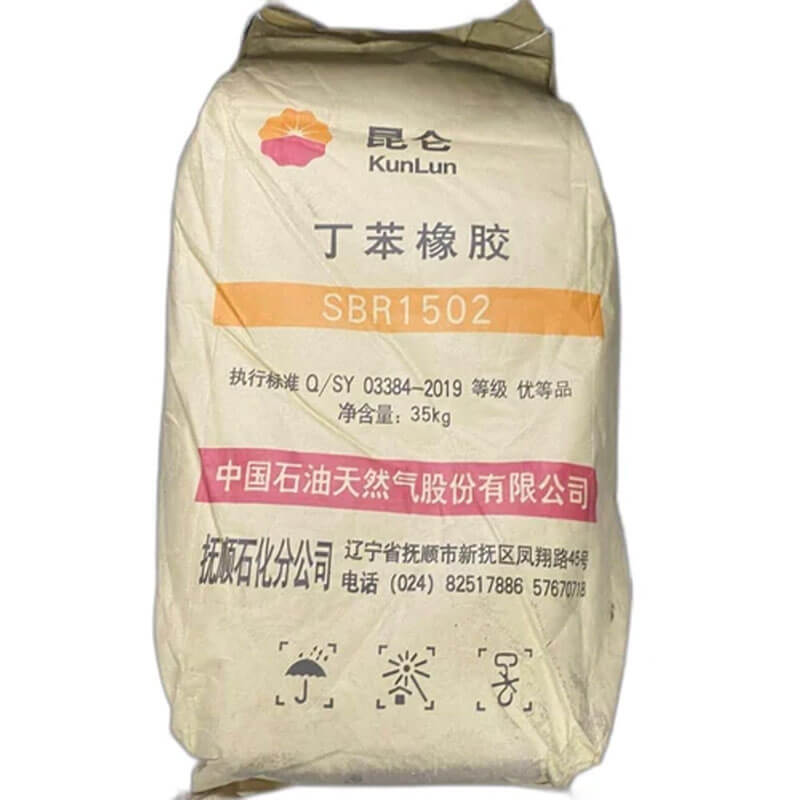
Styrene‑Butadiene Rubber SBR 1502

    • Product Name: Styrene‑Butadiene Rubber SBR 1502
    • Factroy Site: No. 45 Fengxiang Road, Xinfu District, Fushun City, Liaoning Province
    • Price Inquiry: sales4@ascent-chem.com
    • Manufacturer: PetroChina Fushun Petrochemical Company
    • CONTACT NOW
    Specifications
    HS Code 895873
    Product Name Styrene-Butadiene Rubber SBR 1502
    Polymerization Type Cold emulsion polymerized
    Bound Styrene Content 23.5%
    Mooney Viscosity Ml 1 4 100 C 52 MU
    Specific Gravity 0.94
    Volatile Matter 0.75% max
    Ash Content 0.75% max
    Organic Acid Content 5.00%
    Soap Content 0.50% max
    Antioxidant Non-staining
    Tensile Strength 27 MPa min
    Elongation At Break 450% min
    300 Modulus 14.5 MPa

    As an accredited Styrene‑Butadiene Rubber SBR 1502 factory, we enforce strict quality protocols—every batch undergoes rigorous testing to ensure consistent efficacy and safety standards.

    Packing & Storage
    Packing SBR 1502 is packaged in 25 kg net polyethylene-lined woven bags, palletized and shrink-wrapped for safe transport.
    Container Loading (20′ FCL) 20′ FCL: SBR 1502 bales in polyethylene bags, palletized and secured, approx. 20 mt per container.
    Shipping Styrene-Butadiene Rubber SBR 1502 is shipped as compressed bales, typically packed in polyethylene-lined woven bags or shrink-wrapped pallets. It is non-hazardous, but should be transported in clean, dry containers. Avoid excessive heat, direct sunlight, and moisture during transit to preserve polymer quality and prevent bale deformation.
    Storage Store SBR 1502 in a cool, dry, well-ventilated area away from direct sunlight, heat sources, and open flames. Keep original packaging sealed and intact to prevent contamination and moisture pickup. Avoid contact with oxidizing agents. Stack bales on clean pallets, and follow first-in, first-out rotation to maintain quality.
    Shelf Life SBR 1502 has a shelf life of approximately two years when stored in a cool, dry, ventilated area away from sunlight.
    Application of Styrene‑Butadiene Rubber SBR 1502

    At passenger-car radial tread compound development stage, SBR 1502 is evaluated against oil-extended grades because its bound styrene content of 23.5% and non-staining rosin-acid stabilization allow the compound chemist to control wet grip indicators without the confounding variable of aromatic extender oil. In production-scale mixing, the material is charged through a two-pass sequence in an intermeshing internal mixer with chamber volume between 160 L and 270 L: the masterbatch pass drops at 150 °C to 165 °C, and the finalize pass, completed on a two-roll mill or dump extruder at 90 °C to 105 °C, incorporates sulfur and a sulfenamide accelerator without inducing scorch. The addition ratio in tread and retread strip compounds typically places SBR 1502 at 40 phr to 80 phr, with common starting formulations at 65 phr to 75 phr SBR 1502 and 25 phr to 35 phr polybutadiene; naphthenic oil from 5 phr to 15 phr is introduced to offset the absence of extender oil and to keep compound Mooney ML1+4 below 85. The downstream process after mixing is tread profile extrusion through a 90 mm to 150 mm cold-feed extruder with L/D ratio 16:1 to 20:1, followed by tire building and segmented press curing at 150 °C to 170 °C, with cure time set from rotorless rheometer tc90 at 1.67 Hz oscillation. Compliance evaluation is anchored to ASTM D3185 mixed according to ASTM D3182, vulcanizate tensile properties tested under ISO 37 or ASTM D412, and finished tire performance verified under FMVSS 139 and UN ECE R30/R117 requirements for endurance, wet grip, and pass-by noise. Terminal products include radial passenger-car tire treads, precured retread strips, cushion gum, and sidewall veneer compounds. On production lines, the largest bottleneck is the finalize-pass scorch window: when mill stock temperature exceeds 105 °C due to insufficient cooling, scorch time falls below the extrusion buffer. The operational boundary for direct substitution is equally clear: because SBR 1502 is non-oil-extended, replacement of an oil-extended grade without recalibrating oil and filler levels raises mixer torque and increases scorch risk during high-shear second passes; when ambient relative humidity exceeds 60%, hygroscopic fillers require pre-drying before open-mill dispersion.

    What Abrasion Loss Ceiling Governs SBR 1502 Cover Compounds for Bulk-Handling Belts?

    Bulk-handling belt covers that must remain below the DIN 22102-1 abrasion loss ceiling are frequently based on SBR 1502 when the required loss is no greater than 150 mm³ under ISO 4649 method A and the operating environment does not demand oil-extended or solution-polymerized alternatives. The addition ratio in cover stock falls between 60 phr and 100 phr; when ambient-temperature cut resistance is prioritized over raw material cost, 70 phr SBR 1502 is blended with 30 phr natural rubber or butadiene rubber to lift trouser tear strength under ISO 34-1 without producing a hysteresis level that would damage power consumption on long overland conveyors. Mixing is executed as a single-stage masterbatch in a 160 L to 270 L internal mixer at dump temperatures 155 °C to 170 °C, then terminated on an open mill with sulfur, MBTS, and diphenylguanidine if maturation speed requires adjustment. The calendering process applies the cover skim onto EP or NN carcass plies through a three-roll or four-roll calender with 0.6 mm to 1.2 mm thickness control, followed by continuous Rotocure vulcanization or static press curing at 150 °C to 160 °C. The cured cover vulcanizate is expected to retain 60 Shore A to 70 Shore A hardness and a tensile strength above 18 MPa to satisfy ISO 14890 requirements for general-duty rubber-covered textile conveyor belts. Terminal products include abrasion-resistant top covers and friction-optimized bottom covers for aggregate, cement clinker, coal, and grain terminal belts. Calender build-up on the bottom roll is a repeat failure mode when low-oil cover compound drops below 55 phr carbon black; operators must adjust roll temperature differential to prevent sheet pickup. Process limitation: cover stock exposed to outdoor UV service must contain antiozonant at 1 phr to 2 phr and carbon black not less than 40 phr; otherwise surface cracking appears within the first seasonal exposure cycle.

    In high-volume safety footwear plants, direct injection outsole compounding with SBR 1502 is normalized where the cost-density relationship and Shore A hardness control are more critical than cut-growth superiority. The addition ratio for solid outsole compounds is typically 70 phr to 100 phr SBR 1502, with the remainder selected from natural rubber or cis-butadiene rubber when flex-crack resistance is a specification variable. Mixing is performed in a 120 L internal mixer with drop temperature 140 °C to 155 °C, followed by strip cooling and two-roll mill addition of sulfur and accelerators at 70 °C to 80 °C. The prepared compound is either press-cured in multi-cavity compression molds at 155 °C to 165 °C for 8 min to 12 min or injected through an injection molding machine with clamping force 200 t to 350 t at barrel temperature 80 °C to 110 °C and mold temperature 160 °C to 170 °C. Finished safety footwear outsole compliance must satisfy ISO 20345 and ASTM F2413, with abrasion resistance tested under ISO 20871 and slip resistance determined under ASTM F2913. Terminal products include dual-density work boot outsoles, casual cup soles, anti-slip sole sheets, and welder boot compounds. A production-scale porosity defect is observed when moisture in calcium carbonate or silica fillers exceeds 0.3%, producing steam-related bubbles during direct injection curing. Limitation: SBR 1502 outsole compounds exhibit lower cut growth resistance than natural rubber at equal hardness; published data for severe flex-crack service specific to this configuration is limited, so compounds requiring repeated deep flexing should limit SBR 1502 to 70 phr or below.

    When Solids Content Falls Below 25 wt% in Spray-Applied SBR 1502 Contact Cements

    Solvent-borne contact cements based on SBR 1502 are formulated at 15 wt% to 35 wt% solids depending on spray nozzle configuration and substrate porosity; the addition ratio in the dry adhesive film is 100 phr SBR 1502, with 30 phr to 60 phr C5 or rosin ester tackifier and 0.5 phr to 2 phr hindered phenol antioxidant. The downstream production process begins with cold mastication of SBR 1502 on a two-roll mill at 40 °C to 50 °C, followed by dissolution in a sigma-blade or planetary mixer; solvent blends are staged in increments to prevent polymer lumping and to hold batch temperature below 30 °C. When applied by spray or comma coater, the wet film is dried at 60 °C to 80 °C before bonding under nip pressure. Regulatory compliance for EU-placed adhesive goods requires adherence to REACH Annex XVII entry 48 restrictions on toluene content in adhesives supplied to the general public, with VOC emission testing under ASTM D3960 or the equivalent Method 24 framework. Bond performance is characterized under ASTM D903 for peel strength, ASTM D816 for cement viscosity and dried film properties, and ISO 4587 for lap-shear strength of bonded assemblies. Terminal products include spray-applied rubber contact cements for insulation foam lamination, rubber profile attachment, flooring adhesion, and panel lamination. Process limitation: at solids content below 20 wt%, filler and tackifier settling becomes measurable during storage; above 38 wt%, cold-condition viscosity can exceed 20,000 mPa·s and cause airless nozzle plugging on multi-station spray lines.

    When die-cut gaskets are produced from SBR 1502 sheeting, the gauge window of 0.5 mm to 6.0 mm is selected with tensile and compression set targets derived from ASTM D1330 and an ASTM D2000 M2AA 70 Shore A class call. The formulation addition ratio is 80 phr to 100 phr SBR 1502, with N550 carbon black at 40 phr to 70 phr, zinc oxide 3 phr to 5 phr, stearic acid 1 phr to 2 phr, sulfur 1.5 phr to 2.5 phr, and a sulfenamide accelerator at 1 phr to 1.5 phr. Production processing starts in a Banbury internal mixer with dump temperature 155 °C to 170 °C, moves to a two-roll mill for sheet-off at 70 °C to 80 °C, and then enters a three-roll or four-roll calender. Curing is conducted in autoclaves with wrapped drums at 140 °C to 150 °C for 60 min to 120 min, depending on gauge and total load. Physical property verification follows ISO 2781 for density, ASTM D2240 for hardness, and ASTM D412 or ISO 37 for tensile strength at break; die-cut parts are checked against ASTM D1330 for dimensional stability and compression-set performance. Terminal finished product types include flange gaskets, die-cut washers, tank lining sheets, anti-fatigue mats, and conveyor skirting rubber. Autoclave overwrap layer marks are a repeat failure when center-wind tension drifts by more than 5%, producing gauge variation that transfers into die-cut dimensional drift. Operational incompatibility: SBR 1502 sheeting is not recommended for continuous contact with mineral oil or aromatic solvents, with volume swell expected to exceed 50% in ASTM Oil No. 3; applications requiring oil resistance must shift to NBR or CR compounds.

    FMVSS 302-Constrained Interior Mat and Pedal Pad Compounds

    In automotive interior floor mats and pedal pads, SBR 1502 is processed at 80 phr to 100 phr with precipitated calcium carbonate, talc, and styrene-butadiene resin as processing modifier, yielding 70 Shore A to 80 Shore A vulcanizates. The addition ratio for cold-flexible formulations places SBR 1502 at 90 phr and natural rubber at 10 phr when flexibility below 0 °C is specified. The production process uses a 100 L to 160 L internal mixer with dump temperature 145 °C to 160 °C, followed by open mill addition of curatives at 70 °C to 80 °C; the sheet is extruded through a 120 mm cold-feed pin extruder or calendered to thickness, then compression molded at 155 °C to 165 °C for 5 min to 10 min depending on part thickness. Compliance is verified under FMVSS 302 for interior material flammability, requiring a horizontal burn rate not exceeding 102 mm/min, and under ISO 3795 for non-US destinations; antiozonant 6PPD at 1 phr to 2 phr is incorporated to prevent ozone cracking on exposed surfaces. Terminal products include automotive floor mats, trunk mats, pedal pads, and heavy-equipment cab mats. Surface tack on cured mats remains when mold release agent is applied above 1 wt%, causing downstream adhesion in stacked parts. The operational boundary for this compound class is thermal: SBR 1502 is not suitable for engine-compartment parts because continuous service above 90 °C initiates oxidative embrittlement; those positions require CR or ACM compounds.

    Related Articles
    Free Quote

    Competitive Styrene‑Butadiene Rubber SBR 1502 prices that fit your budget—flexible terms and customized quotes for every order.

    For samples, pricing, or more information, please contact us at +8618136850665 or mail to sales4@ascent-chem.com.

    We will respond to you as soon as possible.

    Tel: +8618136850665

    Email: sales4@ascent-chem.com

    Inquiry

    Get Free Quote of PetroChina Fushun Petrochemical Company

    Flexible payment, competitive price, premium service - Inquire now!

    Certification & Compliance
    More Introduction

    Styrene‑Butadiene Rubber SBR 1502 is a cold‑polymerized, non‑pigmented emulsion copolymer in which the bound styrene content is typically controlled between 22.5 and 24.5 mass % and the Mooney viscosity ML 1+4 at 100 °C is commonly specified between 45 and 55 MU. The grade is supplied with a non‑staining stabilizer rather than the dark amine‑based antioxidant system used in SBR 1500, which permits compounding in white, pastel, or transparent rubber goods where surface discoloration would be rejected. In a standard ASTM D3185 evaluation recipe, the polymer is blended with zinc oxide, sulfur, stearic acid, and a sulfenamide accelerator; the resulting vulcanizates are used as general‑purpose elastomers for molded goods, extruded profiles, and calendered sheet. The product is not oil‑extended, so compound hardness and tensile strength are controlled by filler loading rather than by a fixed petroleum extender content. In comparison with hot‑polymerized SBR 1000‑series grades, the cold‑polymerized SBR 1502 exhibits improved abrasion resistance in filled compounds, although the difference is formulation‑dependent and should not be extrapolated without compound‑specific testing.

    Incoming polymer quality is not judged by a single parameter. A typical specification envelope for SBR 1502 accepted by compound suppliers is assembled from the following quality‑control measurements. Volatile matter above 0.75 mass % can generate porosity in thick sections, particularly when curing at low pressure. Ash above 0.75 mass % indicates contamination or coagulation residues that can interfere with translucent compounds. Organic acid and soap levels are monitored because residual emulsifier influences cure rate, water absorption, and adhesion to brass‑coated steel cord in composite constructions.

    Parameter Test method Typical acceptance limit
    Bound styrene ASTM D5775 / ISO 2453 22.5–24.5 mass %
    Mooney viscosity ML 1+4, 100 °C ASTM D1646 / ISO 289-1 45–55 MU
    Volatile matter ASTM D5668 / ISO 248-1 0.75 mass %
    Ash ASTM D5667 / ISO 247 0.75 mass %
    Organic acid ASTM D5774 4.5–6.5 mass %
    Soap ASTM D5774 0.20 mass %
    Stabilizer content Supplier‑specific UV/HPLC method 1.0–1.75 mass %

    Vulcanizate tensile properties are evaluated separately after compounding by ASTM D412 or ISO 37; acceptance limits vary by supplier, filler loading, and cure time. Published data for a specific compound configuration should be obtained from the filler or accelerator supplier rather than inferred from the polymer grade alone.

    What Distinguishes SBR 1502 from Adjacent Emulsion SBR Grades?

    The most immediate contrast is between SBR 1502 and SBR 1500. Both are cold‑polymerized emulsion SBR grades with overlapping bound styrene and Mooney viscosity ranges; the principal difference is the stabilizer package. SBR 1500 contains a staining antioxidant, and its compounds are typically selected for carbon‑black‑filled tire carcass, retread, and mechanical goods applications where surface color is not a requirement. SBR 1502 contains a non‑staining stabilizer, and its compounds are used where heat history or contact with white fillers would make a staining antioxidant unacceptable. This does not imply that SBR 1502 is inherently superior; in long‑term heat aging or dynamic fatigue, a staining antioxidant package may provide greater protection, and the non‑staining stabilizer in SBR 1502 has operational boundaries in high‑temperature aging. Comparative tear and cut‑growth resistance should be evaluated according to ASTM D624 and ASTM D813 rather than assumed from grade selection.

    SBR 1712 differs by the addition of 37.5 phr of extender oil on 100 parts of base polymer. Because the oil is incorporated at the emulsion stage, the effective organic binder is lower in hydrocarbon content and compound density is altered. SBR 1712 is therefore used in high‑volume tire tread and cost‑sensitive mechanical goods where milling energy and compound cost are reduced. SBR 1502, being non‑oil‑extended, allows the compounder to select the plasticizer type and loading, but requires higher mixing energy to incorporate high‑structure fillers. A comparison of the two materials at the same filler loading will show lower Shore A hardness and tensile modulus for SBR 1712 because of the diluent effect.

    Feature SBR 1502 SBR 1500 SBR 1712
    Stabilizer type Non‑staining Staining Supplier‑dependent, often staining
    Bound styrene 22.5–24.5 mass % 22.5–24.5 mass % 22.5–24.5 mass % on base polymer
    Mooney viscosity ML 1+4, 100 °C 45–55 MU 45–55 MU 45–55 MU on oil‑extended compound
    Oil content 0 phr 0 phr 37.5 phr
    Typical application Light‑colored molded and extruded goods Carbon‑black‑filled mechanical goods Tire treads and high‑volume goods

    SBR 1507 is a lower Mooney viscosity member of the non‑pigmented emulsion SBR family. When SBR 1502 is replaced by SBR 1507 in calendering or injection molding, the lower compound viscosity improves flow but reduces green strength. This trade‑off is critical in open‑mill sheeting operations where bank collapse or poor sheet knittability can occur with low green strength. No single Mooney value is universally preferred; the choice is made from a compound viscosity target measured by ASTM D1646.

    Against solution‑polymerized SBR grades, SBR 1502 carries the characteristic branched and broad molecular weight distribution of emulsion polymerization. In high‑performance tire compounds, solution SBR grades may deliver lower rolling resistance and better low‑temperature performance, but SBR 1502 remains selected for general‑purpose applications because of its high green strength, established processing behavior on conventional mixing lines, and lower cost structure.

    When SBR 1502 Is Substituted into Light-Colored Extrusion Compounds

    Substitution of SBR 1502 into a white or pastel extrusion formula changes both rheology and stabilizer response. A typical cold‑feed extruder specification for a 60–70 Shore A compound uses a barrel temperature profile of 70 °C to 90 °C, a head temperature not exceeding 100 °C, and a screw L/D of 12:1 to 16:1. Because SBR 1502 is not oil‑extended, high‑structure fillers such as precipitated silica increase compound viscosity; the compounder should monitor Mooney viscosity ML 1+4 at 100 °C and Mooney stress relaxation to avoid excessive die swell and poor dimensional control. The non‑staining stabilizer package does not prevent thermal oxidation during mixing, and batch dump temperatures above 155 °C can reduce scorch safety in sulfur‑cure systems. Two‑stage mixing is the default practice: the first stage disperses filler, zinc oxide, stearic acid, and process aids to a dump temperature of 140–155 °C; the second stage incorporates sulfur and accelerators at or below 95 °C on a mill or in a low‑speed internal mixer.

    In silica‑filled formulations, the addition of a bifunctional organosilane such as TESPT at 8 mass % based on silica is common, and the coupling reaction requires a sufficient first‑stage temperature‑time window. If the first‑stage temperature is too low, the silanization reaction remains incomplete, which is visible as higher compound viscosity and lower modulus in the cured state, measured by ASTM D412. If the temperature is too high, premature crosslinking of the silane can occur and the compound may exhibit rough extrusion surfaces.

    Sulfur demand for SBR 1502 is lower than for natural rubber because the backbone unsaturation is lower. In a conventional cure system, sulfur at 1.75 phr with 1.0 phr of TBBS and 0.25 phr of tetramethylthiuram disulfide is usable for compression molding; for improved reversion resistance, a semi‑efficient vulcanization system at 1.2 phr sulfur and higher accelerator ratio is applied. Cure times are established on an oscillating disc rheometer at 160 °C following ASTM D2084 or a moving‑die rheometer following ISO 6502, with t90 typically used as the press cure reference.

    Thick sections may require a lower cure temperature to avoid overcure of the exterior because of low thermal conductivity. For sections above 10 mm, mold temperature should be reduced toward 140 °C and cure time extended until the center-of-mass state of cure is confirmed by rheometer heat-transfer simulation or direct temperature measurement.

    In direct‑molded footwear soling, SBR 1502 is often blended with natural rubber or butadiene rubber to balance flex crack resistance and abrasion. Footwear soling compounds typically contain 60–80 phr precipitated silica or clay and a light‑colored pigment loading. Molding is carried out in multi‑cavity compression presses at 150–160 °C for 8–12 min, depending on sole thickness; injection molding requires a clamp force sufficient to prevent flash and a compound Mooney viscosity below 80 MU to fill complicated cavity geometries. The use of SBR 1502 rather than SBR 1500 prevents amber discoloration at the sole surface under UV exposure, though the non‑staining stabilizer alone does not provide sufficient ozone protection for outdoor footwear. Paraffin wax at 1–2 phr or a non‑staining antiozonant is required for dynamic ozone resistance.

    In light‑duty conveyor belt covers, SBR 1502 is compounded with carbon black at lower loadings or with mineral fillers. Cover compounds are calendered onto fabric plies on three‑roll calendars with roll temperatures between 60 °C and 90 °C. The absence of a staining antioxidant reduces contact discoloration when the belt carries packaged goods. Abrasion resistance is measured by DIN 53516 or ASTM D5963, and typical volume loss for a 65 Shore A mineral‑filled cover is formulation‑dependent; published data for this specific configuration should be obtained from the filler supplier rather than inferred from polymer grade.

    SBR 1502 is used in air and water hose tubes and covers where oil resistance is not required. In non‑black covers, titanium dioxide at 5–10 phr is used for tinting; the stabilizer system in SBR 1502 minimizes yellowing from the polymer phase, but external UV stabilizers are still needed for long outdoor service.

    The operational boundary of SBR 1502 includes poor resistance to petroleum oils, aromatic solvents, and strong ozone environments. It is not a replacement for nitrile rubber in fuel or hydraulic service, and contact with copper or manganese compounds can accelerate oxidative degradation; published data for specific solvent immersion is available through ASTM D471 testing, not from grade comparisons alone.

    Regulatory and Standard Compliance Matrix

    Compliance of SBR 1502 with food-contact or medical requirements cannot be assigned to the raw polymer alone. The finished compound must be tested under the applicable end-use standard. For repeated-use rubber articles in food-contact applications, a compound based on SBR 1502 may be formulated to meet 21 CFR 177.2600, provided that all additives, cure residuals, and migration limits are verified on the final article. REACH compliance under EU 1907/2006 requires confirmation of registration for the polymer and any intentionally added substances, while RoHS compliance under 2011/65/EU must address lead, cadmium, and other restricted substances introduced through pigments or fillers rather than the base elastomer. Raw polymer certification typically includes ASTM D1646, ASTM D5775, ASTM D5668, and ASTM D5667, but does not substitute for compound-level regulatory testing.